What to expect from the ECB (and DNB) in 2027-2029: supervisory priorities and reforms for banks
On 19 November 2026, the European Central Bank (ECB) published its supervisory priorities for 2027-2029. In this annual document, the ECB outlines the most important risks and vulnerabilities for banks that fall under its supervision (i.e. significant institutions), based on the outcomes of its ongoing supervision activities, including its Supervisory Review and Evaluation Process (SREP) of individual banks. To address these risks and vulnerabilities, the ECB outlines its supervisory agenda for the period 2027-2029. This document is a very accurate predictor of the ECB’s and DNB’s financial supervision in 2027.
Similar to last year, when the ECB issued its supervisory priorities for 2026-2028, banks have been facing geopolitical conflicts, which posed macro-financial risks to economic growth, thereby increasing inflation and uncertainty. In 2026, military conflicts and trade barriers are still ongoing. Unsurprisingly, the ECB’s supervisory priorities for 2027-2029 are broadly the same as last year.
For the coming years, the ECB’s supervisory priorities are as follows:
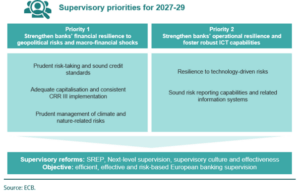
1. Strengthening banks’ financial resilience to geopolitical risks and macro-financial shocks:
a. Prudent risk-taking and sound credit standards.
- Credit underwriting: The ECB will carry out targeted reviews of creditworthiness assessments in residential real estate and corporate lending, and an on-site inspection campaign on credit underwriting standards and loan pricing.
- Exposures to non-bank financial institutions (NBFIs): Earlier reviews revealed shortcomings in banks’ management of counterparty credit risk towards NBFIs. Earlier in 2026, redemption pressures in private credit funds did not lead to a widespread deterioration, and banks’ direct exposures remain contained. New on-site inspection campaigns will focus on fund financing and asset-based lending, particularly to private equity and private credit.
b. Adequate capitalisation and consistent implementation of CRR III.
- Capital planning: The ECB will continue to assess banks’ internal capital adequacy assessment processes (ICAAP), focusing on capital projections and adverse scenario management. The 2027 EU-wide stress test will, for the first time, include climate-related transition and physical risks.
- CRR III implementation: The ECB announced that it will focus on the accurate calculation of risk-weighted assets under the more granular and risk-sensitive standardised approaches of CRR III, and will extend its targeted reviews to more banks.
c. Prudent management of climate and nature-related risks.
- Transition planning and physical risk: In 2027, the ECB will conduct a thematic review of banks’ prudential transition planning capabilities in line with CRR III/CRD VI. It will also assess how selected banks identify, measure and respond to physical risk.
2. Strengthening banks’ operational resilience and fostering robust ICT capabilities:
a. Resilience to technology-driven risks.
- Remediation of ICT findings: The 2026 SREP results reveal persistent deficiencies in ICT risk management, mainly in cybersecurity and third-party risk management. Banks should expect on-site inspections on whether previously identified shortcomings have been remediated, as well as threat-led penetration testing in line with DORA.
- Cloud dependencies: The ECB will conduct a targeted review of cloud service provider dependencies, a topic the relevance of which was underlined again by the global Microsoft outage in November 2026.
- AI and quantum computing: The ECB will analyse banks’ action plans on frontier AI models, assess readiness for post-quantum cryptography migration and carry out pilot reviews of AI governance at a limited number of banks.
b. Sound risk reporting capabilities and related information systems
- RDARR remediation: Material deficiencies in risk data aggregation and risk reporting (RDARR) persist, including in data architectures, data quality and reliance on manual processes. The ECB will monitor remediation progresses, and conduct follow-up on-site inspections on this topic.
The ECB supervisory priorities form the basis for the supervisory planning of the Joint Supervisory Teams. Significant institutions should therefore expect the priorities to shape their supervisory engagement with the ECB in the coming years. For less significant institutions, the priorities serve as a reference for national supervisors such as the Dutch Central Bank (DNB) when setting their own proportionate supervisory strategies.
Supervisory reforms
As part of the ECB’s plans to streamline and simplify supervision, banks can expect more efficient and effective oversight, especially resulting from the revised SREP methodology, which includes a revised methodology for setting Pillar 2 requirements. The ECB completed the SREP reform in 2026 (see this link for more information). Its multi-year assessments allow banks and supervisors to focus on the most material risks and major emerging concern. As a result of the reform, SREP decisions have also become shorter.
In the next years, banks can also expect the effects of the “Next-level supervision” project (see link), launched by the ECB in 2025. It aims to streamline and simplify supervision, for example through more delegated decision-making, fast-track approvals of low-risk capital transactions, faster internal model approvals, and more targeted on-site inspections.